Making Tax Digital Penalties Calculator: A £200 Fine at 4 Points, and 3% on Late Tax at Day 15 and Day 30
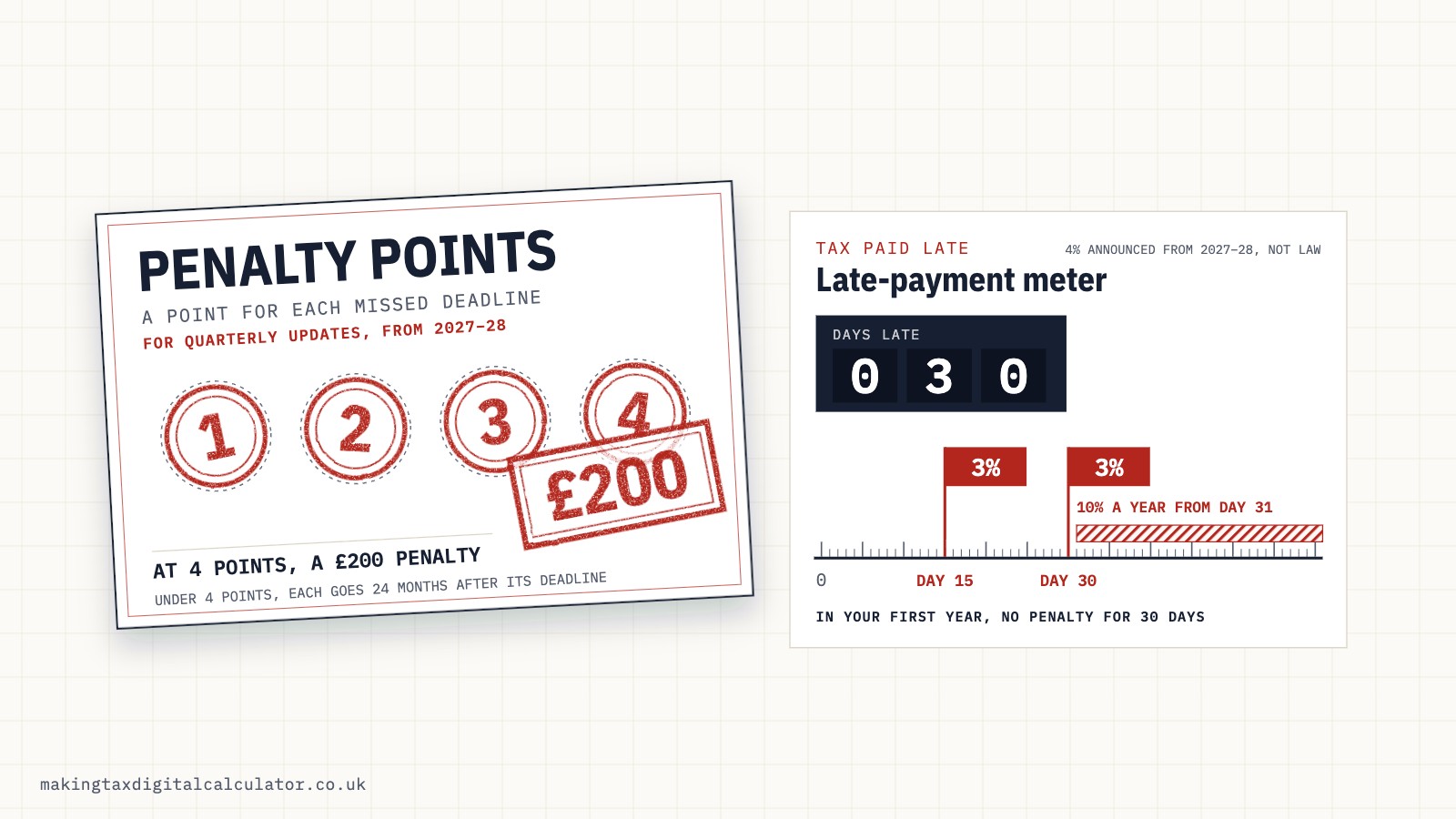
Mark your deadlines on the points card to see each point stamped, the day it goes, and when the £200 penalty starts. Then run a late tax bill along the meter past day 15, day 30 and beyond.
General information, not tax advice. HMRC decides what applies to you. For your own case, ask HMRC or a tax adviser.
Late updates and tax returns
The points card
Mark each deadline on time, late or not sent. A point is stamped for each one missed, with the day it goes written beside it.
Penalty points
Two tax years in Making Tax Digital, from 6 April 2027
- 7 Aug 2027Update 1 · 2027–28Sent 19 Aug 2027, 12 days late1point†all go 1 Feb 2030
- 7 Nov 2027Update 2 · 2027–28On time
- 7 Feb 2028Update 3 · 2027–28Sent 2 Mar 2028, 24 days late2points†all go 1 Feb 2030
- 7 May 2028Update 4 · 2027–28On time
- 7 Aug 2028Update 1 · 2028–29On time
- 7 Nov 2028Update 2 · 2028–29Sent 16 Nov 2028, 9 days late3pointsall go 1 Feb 2030
- 31 Jan 2029Tax return · 2027–28Sent 20 Feb 2029, 20 days late4points£200all go 1 Feb 2030
- 7 Feb 2029Update 3 · 2028–29On time
- 7 May 2029Update 4 · 2028–29On time
- 31 Jan 2030Tax return · 2028–29On time
after 31 Jan 2029
1 penalty of £200
At the threshold. All 4 points go together on 1 February 2030, if you meet every deadline from now on. Until then each deadline you miss costs another £200.
If what the Budget on 28 October 2026 announced becomes law, your late 2027 to 2028 quarterly updates would earn no points. You would have 2 points and £0 in penalties instead.
On the back: the rules the card follows
- One point a deadline Each quarterly update and each tax return sent late earns a point. However many businesses are late for the same deadline, it is still one point.
- The threshold At 4 points you get a £200 penalty, and another £200 for every deadline you miss after that.
- Under the threshold HMRC’s guidance says each point goes 24 months after the deadline you missed.
- At the threshold Points no longer go one by one. All of them go once you have met every deadline for 12 months and sent everything due in the 24 months before.
- The first year No points for late quarterly updates in 2026 to 2027. A late tax return for that year still earns one.
- Announced, not law The Budget on 28 October 2026 said people who must join in April 2027 will get no points for late updates in 2027 to 2028. The card counts them, and marks them †.
- Volunteers If you volunteer, or file only once a year, the threshold is 2 points. Volunteers get no points for late quarterly updates.
- Taking a point away With a reasonable excuse, no point arises for that deadline, and the late update counts as on time when points are removed. HMRC can cancel a point or penalty in exceptional circumstances, such as insolvency. You can appeal either.
3 notes on these figures
The regulations that switched on the new penalties (SI 2026/370) cover people who were in Making Tax Digital in the 2026 to 2027 tax year. Budget 2025 announced that the government would legislate to bring everyone else under them from 6 April 2027. No regulations doing that were on legislation.gov.uk on 6 November 2026. HMRC’s guidance already treats you as under the new penalties, and so does this page.
Budget 2026 (28 October 2026) announced that people who must join in April 2027 will not get penalty points for late quarterly updates in the 2027 to 2028 tax year. That is not law yet, and HMRC’s penalty guidance still says late updates earn points after 2026 to 2027. We count the points under the published rules and show separately what the announcement would change.
We work out when points expire from HMRC’s guidance (a point goes 24 months after the deadline it was for) and Finance Act 2021, Schedule 24, paragraph 8 (all points go together at the threshold), and assume you meet every deadline not listed. HMRC’s online account shows the dates it uses.
Sources: Finance Act 2021, Schedule 24, Paragraph 5 (legislation.gov.uk); The Income Tax (Digital Obligations) Regulations 2026 (legislation.gov.uk); and 11 more. Checked 6 November 2026.
All 13 sources
- Finance Act 2021, Schedule 24, Paragraph 5 (legislation.gov.uk), checked 6 November 2026
- The Income Tax (Digital Obligations) Regulations 2026 (legislation.gov.uk), checked 6 November 2026
- Finance Act 2021, Schedule 24 (legislation.gov.uk), checked 6 November 2026
- Finance Act 2021, Schedule 24, Paragraph 8 (legislation.gov.uk), checked 6 November 2026
- Finance Act 2026, Section 262 (legislation.gov.uk), checked 6 November 2026
- Penalties for Making Tax Digital for Income Tax (GOV.UK), checked 6 November 2026
- Penalties for Making Tax Digital for Income Tax volunteers (GOV.UK), checked 6 November 2026
- Use Making Tax Digital for Income Tax – Send quarterly updates (GOV.UK), checked 6 November 2026
- Get ready for MTD: an agent toolkit – Understanding Making Tax Digital for Income Tax (GOV.UK), checked 6 November 2026
- Budget 2025 — Overview of tax legislation and rates (OOTLAR) (Budget document, GOV.UK), checked 6 November 2026
- Budget 2026 — Overview of tax legislation and rates (OOTLAR) (Budget document, GOV.UK), checked 6 November 2026
- 436,000 sole traders and landlords make their tax digital (HMRC press release, GOV.UK), checked 6 November 2026
- Deadline approaches for first Making Tax Digital quarterly update (HMRC press release, GOV.UK), checked 6 November 2026
Tax paid late
The late-payment meter
Type the bill and drag along the ruler to the day it was paid. The slip below fills in each charge as the days pass its mark.
A bill of £4,200 for 2028–29, due 31 Jan 2030.
Paid 45 days late, on 17 Mar 2030
first penalty, after day 15 and after day 30second penalty, 10% a year from day 31
Tax for2028–29
Due31 Jan 2030
Paid17 Mar 2030day 45
| Tax unpaid | £4,200 |
|---|---|
| First penalty, day 153% of the £4,200 unpaid on 15 Feb 2030 | £126 |
| First penalty, day 30another 3% of the £4,200 unpaid on 2 Mar 2030 | £126 |
| Second penalty, daily10% a year for 15 days, about £1.15 a day | £17.26 |
| Interest7.75% a year for 45 days | £40.13 |
| Penalties and interest | £309.39 |
Announced, not law. If the announced 4% rate becomes law for this payment, the day 15 and day 30 penalties would be £336 instead of £252.
3 notes on these figures
We work out interest and the daily penalty as simple interest, day by day, on a 365-day year, using HMRC’s rate in force on each day. If HMRC counts the days another way, its figure may differ by a few pence.
Budget 2025 announced that the 3% late payment penalties at day 15 and day 30 will rise to 4%. HMRC’s guidance shows 4% for the 2027 to 2028 tax year, but pages differ on the start (‘April 2027’, ‘1 April 2027’ and ‘the 2027 to 2028 tax year’). The law still says 3%, so we use 3% and show the 4% figure separately.
The regulations that switched on the new penalties (SI 2026/370) cover people who were in Making Tax Digital in the 2026 to 2027 tax year. Budget 2025 announced that the government would legislate to bring everyone else under them from 6 April 2027. No regulations doing that were on legislation.gov.uk on 6 November 2026. HMRC’s guidance already treats you as under the new penalties, and so does this page.
Sources: Finance Act 2021, Schedule 26, Paragraph 5 (legislation.gov.uk); Finance Act 2021, Schedule 26, Paragraph 8 (legislation.gov.uk); and 7 more. Checked 6 November 2026.
All 9 sources
- Finance Act 2021, Schedule 26, Paragraph 5 (legislation.gov.uk), checked 6 November 2026
- Finance Act 2021, Schedule 26, Paragraph 8 (legislation.gov.uk), checked 6 November 2026
- The Finance Act 2021 (Increase in Schedule 26 Penalty Percentages) Regulations 2025 (legislation.gov.uk), checked 6 November 2026
- Penalties for Making Tax Digital for Income Tax (GOV.UK), checked 6 November 2026
- Penalties for Making Tax Digital for Income Tax volunteers (GOV.UK), checked 6 November 2026
- The Tax Agent’s Handbook – Keeping up to date (GOV.UK), checked 6 November 2026
- HMRC interest rates for late and early payments (GOV.UK), checked 6 November 2026
- Budget 2025 — Overview of tax legislation and rates (OOTLAR) (Budget document, GOV.UK), checked 6 November 2026
- HMRC revises interest rates for late payments (HMRC press release, GOV.UK), checked 6 November 2026
Making Tax Digital has two kinds of penalty, and they work quite differently. Miss the deadline for a quarterly update or a tax return and you get a penalty point. Points cost nothing on their own. At 4 points you get a £200 penalty, and another £200 for every deadline you miss after that. Pay your tax late and the charge is a percentage of what you owe, added after day 15 and again after day 30, then a little more each day.
The card and the meter above run on the rules HMRC has published, as we read them on 6 November 2026, through the same engine as the rest of this site. They give an estimate. HMRC decides what you owe, and its letter or your online account has the last word. Nothing you mark or type leaves this page.
How do Making Tax Digital penalty points work?
You get one point for each deadline you miss. Each quarterly update has a deadline, and so does the tax return at the end of the year, and a late one earns a point the moment the deadline passes. Sending it a day later doesn’t undo that. It’s the deadline that counts, not the business. If you’re a sole trader who also lets out a flat, you send updates for both, but missing the same deadline for both is still one point.
Points don’t cost anything until you reach the threshold. For anyone in Making Tax Digital the threshold is 4 points, counted across your quarterly updates and your tax return together. If you volunteer, or only send a yearly return under the new rules, it’s 2.
For people in Making Tax Digital, this replaces the current Self Assessment penalties for a late return, which start with an initial £100. A late return is a missed deadline like any other. It earns a point, and only becomes money when it tips you over the threshold.
When do you get the £200 penalty?
The deadline that takes you to 4 points is the one that brings it. There’s no point after that one. You stay at 4, and each deadline you miss while you’re there costs another £200. Every quarterly update and every return is another chance to add one.
Here’s what happens to someone in from 6 April 2028 who misses every quarterly deadline, one after another, and sends everything else on time.
| Missed | Last one due | Points | Penalties so far |
|---|---|---|---|
| 1 | 7 Aug 2028 | 1 | £0 |
| 2 | 7 Nov 2028 | 2 | £0 |
| 3 | 7 Feb 2029 | 3 | £0 |
| 4 | 7 May 2029 | 4 | £200 |
| 5 | 7 Aug 2029 | 4 | £400 |
| 6 | 7 Nov 2029 | 4 | £600 |
| 7 | 7 Feb 2030 | 4 | £800 |
| 8 | 7 May 2030 | 4 | £1,000 |
- The regulations that switched on the new penalties (SI 2026/370) cover people who were in Making Tax Digital in the 2026 to 2027 tax year. Budget 2025 announced that the government would legislate to bring everyone else under them from 6 April 2027. No regulations doing that were on legislation.gov.uk on 6 November 2026. HMRC’s guidance already treats you as under the new penalties, and so does this page.
- We work out when points expire from HMRC’s guidance (a point goes 24 months after the deadline it was for) and Finance Act 2021, Schedule 24, paragraph 8 (all points go together at the threshold), and assume you meet every deadline not listed. HMRC’s online account shows the dates it uses.
Sources: The Income Tax (Digital Obligations) Regulations 2026 (legislation.gov.uk); Finance Act 2021, Schedule 24 (legislation.gov.uk); Finance Act 2021, Schedule 24, Paragraph 5 (legislation.gov.uk); and 10 more. Checked 6 November 2026.
All 13 sources
- The Income Tax (Digital Obligations) Regulations 2026 (legislation.gov.uk), checked 6 November 2026
- Finance Act 2021, Schedule 24 (legislation.gov.uk), checked 6 November 2026
- Finance Act 2021, Schedule 24, Paragraph 5 (legislation.gov.uk), checked 6 November 2026
- Finance Act 2021, Schedule 24, Paragraph 8 (legislation.gov.uk), checked 6 November 2026
- Finance Act 2026, Section 262 (legislation.gov.uk), checked 6 November 2026
- The Finance Act 2021 (Income Tax and Capital Gains Tax) (Penalties) (Appointed Day: Digitally Obligated Persons) Regulations 2026 (legislation.gov.uk), checked 6 November 2026
- Get ready for MTD: an agent toolkit – Understanding Making Tax Digital for Income Tax (GOV.UK), checked 6 November 2026
- Penalties for Making Tax Digital for Income Tax (GOV.UK), checked 6 November 2026
- Use Making Tax Digital for Income Tax – Send quarterly updates (GOV.UK), checked 6 November 2026
- Penalties for Making Tax Digital for Income Tax volunteers (GOV.UK), checked 6 November 2026
- Budget 2025 — Overview of tax legislation and rates (OOTLAR) (Budget document, GOV.UK), checked 6 November 2026
- 436,000 sole traders and landlords make their tax digital (HMRC press release, GOV.UK), checked 6 November 2026
- Deadline approaches for first Making Tax Digital quarterly update (HMRC press release, GOV.UK), checked 6 November 2026
That’s the worst case. A single late update with every deadline met after it does no harm beyond the point, and the point runs out on its own. When it runs out is the part people find hardest.
When do penalty points expire?
Under the threshold, HMRC’s guidance says each point expires 24 months after the deadline you missed, on its own. A point for an update due on a given day goes on the same day 24 months later, whatever else happens in between. HMRC’s guidance gives those 24 months, and this part follows it.
At the threshold, points stop expiring one by one. Finance Act 2021, Schedule 24, paragraph 8 has them all go together, and only once two things are true. You’ve met every deadline for 12 months in a row. And you’ve sent everything that was due in the 24 months before, late or not. An update you never sent, due within those 24 months, holds the reset back until you send it, so send it even if it’s months late.
The belt below shows both. Each disc is a point, riding a belt that takes 24 months from end to end. Under the threshold, points fall off the end one at a time. At the threshold the belt stops, and nothing falls off until the whole belt is cleared at once.
Under 4 points, each point rides the belt for 24 months and drops off the end
31 Jan 2030 Three points on the belt, for 7 Aug 2028, 7 Feb 2029 and 31 Jan 2030. The oldest has ridden 18 of its 24 months.
1237 Aug 2030 The point from 7 Aug 2028 has ridden its 24 months and drops off. 2 points on the belt.
1237 Feb 2031 The point from 7 Feb 2029 has ridden its 24 months and drops off. 1 point on the belt.
2331 Jan 2032 The point from 31 Jan 2030 has ridden its 24 months and drops off. The belt is empty.
3
At 4 points the belt stops, and later empties all at once
7 May 2029 Point 4 goes on, for 7 May 2029. That is the threshold. A £200 penalty, and the belt stops.
stopped12347 May 2030 Still stopped. 12 months on, nothing has dropped off, though the first point is now 21 months old.
stopped12348 May 2030 Four points drop off at once. By 8 May 2030 every deadline has been met for 12 months and nothing is outstanding, so the whole belt is cleared.
1234
Sources: Finance Act 2021, Schedule 24, Paragraph 8 (legislation.gov.uk); Finance Act 2021, Schedule 24, Paragraph 5 (legislation.gov.uk); and 3 more. Checked 6 November 2026.
All 5 sources
- Finance Act 2021, Schedule 24, Paragraph 8 (legislation.gov.uk), checked 6 November 2026
- Finance Act 2021, Schedule 24, Paragraph 5 (legislation.gov.uk), checked 6 November 2026
- Finance Act 2021, Schedule 24 (legislation.gov.uk), checked 6 November 2026
- Penalties for Making Tax Digital for Income Tax (GOV.UK), checked 6 November 2026
- Penalties for Making Tax Digital for Income Tax volunteers (GOV.UK), checked 6 November 2026
What resets points, and what cancels them
Time is the usual way. A change in your threshold moves your points too, and HMRC can take a point away if you had a good reason for being late. The chart reads from the left, with braces the way old textbooks drew a classification, and the branch your card is on is marked in red.
A penalty point on your recordfor a deadline you missed
Time takes it awayon its own
- Under 4 points. Each point goes 24 months after the deadline you missed, on its own, as HMRC’s guidance says.
- At 4 points. None go one by one. All of them go together once you have met every deadline for 12 months and sent everything due in the 24 months before.
Your threshold movesif your position changes
- Exempt in 2027 to 2028. Your threshold falls from 4 to 2, and your points fall with it, so you are no closer to it.
- Exempt in 2026 to 2027. You go back to the current Self Assessment penalties.
- A volunteer who now has to join. Your threshold rises from 2 to 4, and your points rise with it, so you are no closer to it.
HMRC takes it awayif you ask, or it decides
- A reasonable excuse. No point arises for that deadline. The late update or return also counts as on time when HMRC works out whether points can be removed. Tell HMRC, or appeal the point.
- Exceptional circumstances. HMRC can cancel a point or a penalty, for example on insolvency.
- An appeal. You can appeal a point, or a penalty, if you think HMRC got it wrong.
Sources: Finance Act 2021, Schedule 24, Paragraph 8 (legislation.gov.uk); Finance Act 2026, Section 262 (legislation.gov.uk); Penalties for Making Tax Digital for Income Tax (GOV.UK); and 2 more. Checked 6 November 2026.
All 5 sources
- Finance Act 2021, Schedule 24, Paragraph 8 (legislation.gov.uk), checked 6 November 2026
- Finance Act 2026, Section 262 (legislation.gov.uk), checked 6 November 2026
- Penalties for Making Tax Digital for Income Tax (GOV.UK), checked 6 November 2026
- Penalties for Making Tax Digital for Income Tax volunteers (GOV.UK), checked 6 November 2026
- Budget 2025 — Overview of tax legislation and rates (OOTLAR) (Budget document, GOV.UK), checked 6 November 2026
Two things that people expect to help don’t. Paying the £200 doesn’t clear your points. And sending the late update straight after the deadline doesn’t stop the point being given. What clears points at the threshold is a clean run of deadlines, with nothing left outstanding behind it.
Are there penalties for late quarterly updates in the first year?
Not in 2026 to 2027. HMRC’s guidance and Budget 2025 both say late quarterly updates in that tax year earn no points. You still have to send them before you can send your tax return, and a late return or a late payment for that year is still penalised. HMRC’s guidance states it, and the calculator applies it as HMRC states it.
For people who must join in April 2027, the Budget on 28 October 2026 announced the same for their first year, with no points for late quarterly updates in 2027 to 2028. That is announced, not law. HMRC’s penalty guidance still says late updates earn points in every tax year after 2026 to 2027, with no exception. So the card counts those points, marks each one with a dagger, and says underneath what the announcement would change for you.
That’s why the card at the top starts on 6 April 2027. Under the published rules its example reaches 4 points and a £200 penalty, and two of those points carry the dagger. If the announcement becomes law, they go, and so does the penalty.
Who is under the new penalties, and from when?
If you were in Making Tax Digital in 2026 to 2027, the new penalties are law for you. The regulations that switched them on (SI 2026/370) cover that group.
Not sure which April is yours? Our homepage works out the day you start from your income, and the qualifying income calculator adds up the turnover and rents that decide it.
For everyone else it’s announced, not law yet. Budget 2025 said the government would bring everyone who sends a Self Assessment return under the new penalties from 6 April 2027, in Making Tax Digital or not. We hadn’t found those regulations on legislation.gov.uk by 6 November 2026. HMRC’s guidance assumes the new penalties apply to you if you join later, and the card and the meter do the same.
A tax year before you joined stays under the current Self Assessment penalties. For a late return they start with an initial £100. For tax paid late they’re 5% of the tax still unpaid at 30 days, at 6 months and at 12 months. HMRC’s own example is someone in from 6 April 2026. Their 2025–26 return, due 31 January 2027, is still under the current penalties.
The new penalties don’t cover partnership returns, trust and estate returns, or returns for a non-resident company. And if you’re registered for VAT, your VAT penalty points are a separate tally. A late VAT return never adds to your income tax points, or the other way round.
How do late payment penalties work?
If tax is still unpaid after day 15, HMRC charges the first penalty, at 3% of what’s unpaid then. If it’s still unpaid after day 30, the first penalty grows by another 3% of what’s unpaid at that point. From day 31 the second penalty runs, at 10% a year, day by day, on whatever is still owed, until you pay. Those are the names HMRC and the law (Finance Act 2021, Schedule 26) use, so they’ll match any letter you get.
Paying part of the bill helps, because each charge is a percentage of what’s unpaid on its day. HMRC’s guidance says the second penalty runs for up to 2 years. Schedule 26, paragraph 8, which sets that penalty, doesn’t contain the limit. The meter follows HMRC and stops it after 2 years, and says what it would be without the limit.
These penalties are for the balancing payment and for tax due after an amendment or an assessment. Payments on account don’t get late payment penalties. HMRC charges late payment interest from the first day a payment is late, and the calculator applies that to payments on account too.
Callum lets out two flats. He joined in April 2027, so his bill for 2028–29 comes from his second year and has no first-year easement. It’s £4,200, and he pays it 45 days late. By then the whole first penalty has been charged, both its parts, and the second penalty has been running for a fortnight. This is the meter’s own slip for him.
Tax for2028–29
Due31 Jan 2030
Paid17 Mar 2030day 45
| Tax unpaid | £4,200 |
|---|---|
| First penalty, day 153% of the £4,200 unpaid on 15 Feb 2030 | £126 |
| First penalty, day 30another 3% of the £4,200 unpaid on 2 Mar 2030 | £126 |
| Second penalty, daily10% a year for 15 days, about £1.15 a day | £17.26 |
| Interest7.75% a year for 45 days | £40.13 |
| Penalties and interest | £309.39 |
Announced, not law. If the announced 4% rate becomes law for this payment, the day 15 and day 30 penalties would be £336 instead of £252.
Sources: Finance Act 2021, Schedule 26, Paragraph 5 (legislation.gov.uk); Finance Act 2021, Schedule 26, Paragraph 8 (legislation.gov.uk); and 7 more. Checked 6 November 2026.
All 9 sources
- Finance Act 2021, Schedule 26, Paragraph 5 (legislation.gov.uk), checked 6 November 2026
- Finance Act 2021, Schedule 26, Paragraph 8 (legislation.gov.uk), checked 6 November 2026
- The Finance Act 2021 (Increase in Schedule 26 Penalty Percentages) Regulations 2025 (legislation.gov.uk), checked 6 November 2026
- Penalties for Making Tax Digital for Income Tax (GOV.UK), checked 6 November 2026
- Penalties for Making Tax Digital for Income Tax volunteers (GOV.UK), checked 6 November 2026
- The Tax Agent’s Handbook – Keeping up to date (GOV.UK), checked 6 November 2026
- HMRC interest rates for late and early payments (GOV.UK), checked 6 November 2026
- Budget 2025 — Overview of tax legislation and rates (OOTLAR) (Budget document, GOV.UK), checked 6 November 2026
- HMRC revises interest rates for late payments (HMRC press release, GOV.UK), checked 6 November 2026
Is there a grace period for late payment in the first year?
Yes. For your first tax year under the new penalties, HMRC won’t charge a late payment penalty if you pay within 30 days. It’s a one-off. From your second year the first penalty comes after day 15 as usual. Interest runs from the start either way.
HMRC doesn’t say directly what happens if you pay after day 30 in that first year. Its table suggests the whole first penalty then applies, so that’s what the meter does. Volunteers get the 30 days too, in their own first year. Only someone who volunteered and is later required to join keeps the usual 15 days.
Hannah joined in April 2027. Her first bill is £2,600. Paid on day 28 it costs her a little interest and nothing else. Paid on day 40, the whole first penalty applies, as if the easement had never been there.
Tax for2027–28
Due31 Jan 2029
Paid28 Feb 2029day 28
| Tax unpaidfirst year in Making Tax Digital | £2,600 |
|---|---|
| First penalty, day 15first year: none if paid by day 30 | none |
| First penalty, day 30first year: none if paid by day 30 | – |
| Second penalty, daily10% a year from day 31 | – |
| Interest7.75% a year for 28 days | £15.46 |
| Penalties and interest | £15.46 |
Tax for2027–28
Due31 Jan 2029
Paid12 Mar 2029day 40
| Tax unpaidfirst year in Making Tax Digital | £2,600 |
|---|---|
| First penalty, day 153% of the £2,600 unpaid on 15 Feb 2029 | £78 |
| First penalty, day 30another 3% of the £2,600 unpaid on 2 Mar 2029 | £78 |
| Second penalty, daily10% a year for 10 days, about £0.71 a day | £7.12 |
| Interest7.75% a year for 40 days | £22.08 |
| Penalties and interest | £185.20 |
Announced, not law. If the announced 4% rate becomes law for this payment, the day 15 and day 30 penalties would be £208 instead of £156.
Sources: Finance Act 2021, Schedule 26, Paragraph 5 (legislation.gov.uk); Finance Act 2021, Schedule 26, Paragraph 8 (legislation.gov.uk); The Finance Act 2021 (Increase in Schedule 26 Penalty Percentages) Regulations 2025 (legislation.gov.uk); and 3 more. Checked 6 November 2026.
All 6 sources
- Finance Act 2021, Schedule 26, Paragraph 5 (legislation.gov.uk), checked 6 November 2026
- Finance Act 2021, Schedule 26, Paragraph 8 (legislation.gov.uk), checked 6 November 2026
- The Finance Act 2021 (Increase in Schedule 26 Penalty Percentages) Regulations 2025 (legislation.gov.uk), checked 6 November 2026
- Penalties for Making Tax Digital for Income Tax (GOV.UK), checked 6 November 2026
- Penalties for Making Tax Digital for Income Tax volunteers (GOV.UK), checked 6 November 2026
- Budget 2025 — Overview of tax legislation and rates (OOTLAR) (Budget document, GOV.UK), checked 6 November 2026
Will late payment penalties go up to 4%?
It’s announced, not law. Budget 2025 said the two 3% parts of the first penalty, at day 15 and day 30, would each rise to 4%. HMRC’s guidance already shows 4% for 2027 to 2028, but its pages give the start in three different ways. The law still says 3%, so the meter charges 3% and prints the higher figure underneath. The second penalty’s rate of 10% a year stays as it is.
Under each slip on this page the higher figure is printed as an announcement, never added to the total. Run your own bill along the meter and you’ll see what the change would cost you, if it becomes law.
How much interest does HMRC charge on late tax?
Interest runs from the day after the tax was due until the day you pay, on every pound still unpaid. The rate is the Bank of England base rate plus 4 percentage points. When we checked on 6 November 2026 it was 7.75% a year, the rate since 9 January 2026.
Interest isn’t a penalty, so the first-year easement doesn’t stop it and nor does a payment plan. The meter works it out day by day, as simple interest on a 365-day year at the rate in force each day. If HMRC counts the days another way, its figure may differ from ours by a few pence. If the base rate changes after the day we checked, the meter carries on at the last rate it knows.
Does a payment plan stop late payment penalties?
It pauses them from the day you contact HMRC, as long as a plan is agreed and you keep to it. Ask by day 15 and you avoid the first penalty altogether. Ask by day 30 and you avoid its day 30 part. The second penalty stops the day before you asked. Interest keeps running all the way through.
If the plan breaks, HMRC may charge the penalties as if there had never been one. Tick the box under the meter’s ruler to see the difference. If Callum had asked for time to pay on day 10, his slip would read like this.
Tax for2028–29
Due31 Jan 2030
Paid17 Mar 2030day 45
| Tax unpaid | £4,200 |
|---|---|
| First penalty, day 15paused: time to pay asked for on day 10 | none |
| First penalty, day 30paused: time to pay asked for on day 10 | none |
| Second penalty, dailypaused: time to pay asked for on day 10 | none |
| Interest7.75% a year for 45 days, still running on the plan | £40.13 |
| Penalties and interest | £40.13 |
Sources: Finance Act 2021, Schedule 26, Paragraph 5 (legislation.gov.uk); Finance Act 2021, Schedule 26, Paragraph 8 (legislation.gov.uk); and 7 more. Checked 6 November 2026.
All 9 sources
- Finance Act 2021, Schedule 26, Paragraph 5 (legislation.gov.uk), checked 6 November 2026
- Finance Act 2021, Schedule 26, Paragraph 8 (legislation.gov.uk), checked 6 November 2026
- The Finance Act 2021 (Increase in Schedule 26 Penalty Percentages) Regulations 2025 (legislation.gov.uk), checked 6 November 2026
- Penalties for Making Tax Digital for Income Tax (GOV.UK), checked 6 November 2026
- Penalties for Making Tax Digital for Income Tax volunteers (GOV.UK), checked 6 November 2026
- The Tax Agent’s Handbook – Keeping up to date (GOV.UK), checked 6 November 2026
- HMRC interest rates for late and early payments (GOV.UK), checked 6 November 2026
- Budget 2025 — Overview of tax legislation and rates (OOTLAR) (Budget document, GOV.UK), checked 6 November 2026
- HMRC revises interest rates for late payments (HMRC press release, GOV.UK), checked 6 November 2026
Can you appeal a penalty point or a penalty?
Yes. If you had a reasonable excuse for missing a deadline, no penalty point arises for it. The late update or return also counts as on time when HMRC works out whether your points can be removed. You can appeal a point or a penalty if you think HMRC got it wrong, and HMRC can cancel either in exceptional circumstances, such as insolvency.
HMRC’s guide, Penalties for Making Tax Digital for Income Tax, explains how to appeal.
Penalties if you volunteer
Volunteers get no points for late quarterly updates, and their threshold for late returns is 2 points rather than 4. Like everyone else, they get the first-year 30 days for late payment, in their own first year. For 2024 to 2025, volunteers were charged lower rates, 2% at day 15, 2% at day 30 and 4% a year after that.
If you volunteer and then have to join, your threshold rises from 2 to 4 and your points rise with it, so you’re no closer to a penalty than you were. It works the other way too. Someone who becomes exempt in 2027 to 2028 sees the threshold fall from 4 to 2, with their points falling to match.
Worked examples
Aisha is a wedding photographer, in from 6 April 2028. Her first update goes in 5 days late while she’s away on a shoot. A year later another one slips by 3 days, and her 2028–29 tax return goes in 10 days late. That’s three points, no penalty, and each point goes 24 months after its own deadline. If she misses nothing else, her record is clean again on the last of those dates.
| Due | What | Sent | Points | Penalty | Point goes |
|---|---|---|---|---|---|
| 7 Aug 2028 | Update 1 2028–29 | 12 Aug 2028 | 1 | – | 7 Aug 2030 |
| 7 Aug 2029 | Update 1 2029–30 | 10 Aug 2029 | 2 | – | 7 Aug 2031 |
| 31 Jan 2030 | Tax return 2028–29 | 10 Feb 2030 | 3 | – | 31 Jan 2032 |
Sources: Finance Act 2021, Schedule 24, Paragraph 5 (legislation.gov.uk); The Income Tax (Digital Obligations) Regulations 2026 (legislation.gov.uk); and 11 more. Checked 6 November 2026.
All 13 sources
- Finance Act 2021, Schedule 24, Paragraph 5 (legislation.gov.uk), checked 6 November 2026
- The Income Tax (Digital Obligations) Regulations 2026 (legislation.gov.uk), checked 6 November 2026
- Finance Act 2021, Schedule 24 (legislation.gov.uk), checked 6 November 2026
- Finance Act 2021, Schedule 24, Paragraph 8 (legislation.gov.uk), checked 6 November 2026
- Finance Act 2026, Section 262 (legislation.gov.uk), checked 6 November 2026
- Penalties for Making Tax Digital for Income Tax (GOV.UK), checked 6 November 2026
- Penalties for Making Tax Digital for Income Tax volunteers (GOV.UK), checked 6 November 2026
- Use Making Tax Digital for Income Tax – Send quarterly updates (GOV.UK), checked 6 November 2026
- Get ready for MTD: an agent toolkit – Understanding Making Tax Digital for Income Tax (GOV.UK), checked 6 November 2026
- Budget 2025 — Overview of tax legislation and rates (OOTLAR) (Budget document, GOV.UK), checked 6 November 2026
- Budget 2026 — Overview of tax legislation and rates (OOTLAR) (Budget document, GOV.UK), checked 6 November 2026
- 436,000 sole traders and landlords make their tax digital (HMRC press release, GOV.UK), checked 6 November 2026
- Deadline approaches for first Making Tax Digital quarterly update (HMRC press release, GOV.UK), checked 6 November 2026
Ben joined in April 2027 and had a messy couple of years. His fourth missed deadline was his 2027–28 tax return, which brought the first £200. A week later he missed an update as well, and that cost a second £200. His points can’t go until he’s had 12 months of deadlines met, counted from that last miss.
| Due | What | Sent | Points | Penalty | Point goes |
|---|---|---|---|---|---|
| 7 Nov 2027 | Update 2 2027–28 | 13 Nov 2027 | 1 † | – | all on 8 Feb 2030 |
| 7 May 2028 | Update 4 2027–28 | 11 May 2028 | 2 † | – | all on 8 Feb 2030 |
| 7 Aug 2028 | Update 1 2028–29 | 18 Aug 2028 | 3 | – | all on 8 Feb 2030 |
| 31 Jan 2029 | Tax return 2027–28 | 15 Feb 2029 | 4 | £200 | all on 8 Feb 2030 |
| 7 Feb 2029 | Update 3 2028–29 | 15 Feb 2029 | (at 4) | £200 | – |
- † If what the Budget on 28 October 2026 announced becomes law, your late 2027 to 2028 quarterly updates would earn no points. You would have 3 points and £0 in penalties instead.
Sources: Finance Act 2021, Schedule 24, Paragraph 5 (legislation.gov.uk); The Income Tax (Digital Obligations) Regulations 2026 (legislation.gov.uk); and 11 more. Checked 6 November 2026.
All 13 sources
- Finance Act 2021, Schedule 24, Paragraph 5 (legislation.gov.uk), checked 6 November 2026
- The Income Tax (Digital Obligations) Regulations 2026 (legislation.gov.uk), checked 6 November 2026
- Finance Act 2021, Schedule 24 (legislation.gov.uk), checked 6 November 2026
- Finance Act 2021, Schedule 24, Paragraph 8 (legislation.gov.uk), checked 6 November 2026
- Finance Act 2026, Section 262 (legislation.gov.uk), checked 6 November 2026
- Penalties for Making Tax Digital for Income Tax (GOV.UK), checked 6 November 2026
- Penalties for Making Tax Digital for Income Tax volunteers (GOV.UK), checked 6 November 2026
- Use Making Tax Digital for Income Tax – Send quarterly updates (GOV.UK), checked 6 November 2026
- Get ready for MTD: an agent toolkit – Understanding Making Tax Digital for Income Tax (GOV.UK), checked 6 November 2026
- Budget 2025 — Overview of tax legislation and rates (OOTLAR) (Budget document, GOV.UK), checked 6 November 2026
- Budget 2026 — Overview of tax legislation and rates (OOTLAR) (Budget document, GOV.UK), checked 6 November 2026
- 436,000 sole traders and landlords make their tax digital (HMRC press release, GOV.UK), checked 6 November 2026
- Deadline approaches for first Making Tax Digital quarterly update (HMRC press release, GOV.UK), checked 6 November 2026
Two of Ben’s points come from 2027 to 2028 updates, so they carry the dagger. If the Budget announcement becomes law, those two go, he never reaches the threshold and both £200 penalties fall away. Until it is law, plan on the published rules. Put your own deadlines on the card at the top of the page to see where you stand.