Tax year 2025–26 · decides April 2027
Do you need Making Tax Digital, and from when?
Put in what your businesses took and what your lettings brought in. We add up your qualifying income the way HMRC does, line by line, and tell you the day you start.
Nothing you type leaves this page. It's worked out in your browser.
Your 2025–26
EXAMPLE FIGURES · PUT IN YOUR OWN
YOUR START DATE
6 April 2027 at the latest
Your 2025 to 2026 tax return decides it, with qualifying income of £33,600, which is more than £30,000.
- 6 Apr 2026 Not known yet: We need your qualifying income for 2024 to 2025. If it was more than £50,000, Making Tax Digital applies for 2026 to 2027.
- 6 Apr 2027 In: Your qualifying income for 2025 to 2026 was £33,600, more than £30,000.
- 6 Apr 2028 In: A lower income for 2026 to 2027 would not take you out for 2028 to 2029. Once you are in, a lower income takes you out after 3 tax years in a row with qualifying income not more than the threshold.
General information, not tax advice. HMRC decides what applies to you. For your own case, ask HMRC or a tax adviser.
We assume you were UK resident (foreign rent counts only then), own the same share of every property, and that nothing stopped during the year.
HMRC's manual (SALF1440) says the leaving rule keeps you in for at least 4 tax years. The law and HMRC's own worked example let you leave after 3 tax years in a row at or under the threshold, so that is what we show.
The 2026 regulations (SI 2026/336) are quoted here as made. On 6 November 2026, legislation.gov.uk listed no amendment to them.
Sources: The Income Tax (Digital Obligations) Regulations 2026 (legislation.gov.uk); Use Making Tax Digital for Income Tax - Add or cease income sources (GOV.UK); Find out if and when you need to use Making Tax Digital for Income Tax (GOV.UK); and 6 more. Checked 6 November 2026.
All 9 sources
- The Income Tax (Digital Obligations) Regulations 2026 (legislation.gov.uk), checked 6 November 2026
- Use Making Tax Digital for Income Tax - Add or cease income sources (GOV.UK), checked 6 November 2026
- Find out if and when you need to use Making Tax Digital for Income Tax (GOV.UK), checked 6 November 2026
- Use Making Tax Digital for Income Tax - Using Making Tax Digital for Income Tax for the first time (GOV.UK), checked 6 November 2026
- Use Making Tax Digital for Income Tax - Create digital records (GOV.UK), checked 6 November 2026
- Find out if you can get an exemption from Making Tax Digital for Income Tax (GOV.UK), checked 6 November 2026
- Use Making Tax Digital for Income Tax - If your circumstances change (GOV.UK), checked 6 November 2026
- Work out your qualifying income for Making Tax Digital for Income Tax (GOV.UK), checked 6 November 2026
- SALF1440 - Self Assessment: the legal framework: Exemptions: Exemptions by reference to amount of income (HMRC manual), checked 6 November 2026
How the test works
- Add up your self-employed turnover and your share of any rent, before expenses. Wages, pensions, dividends and interest don't count.
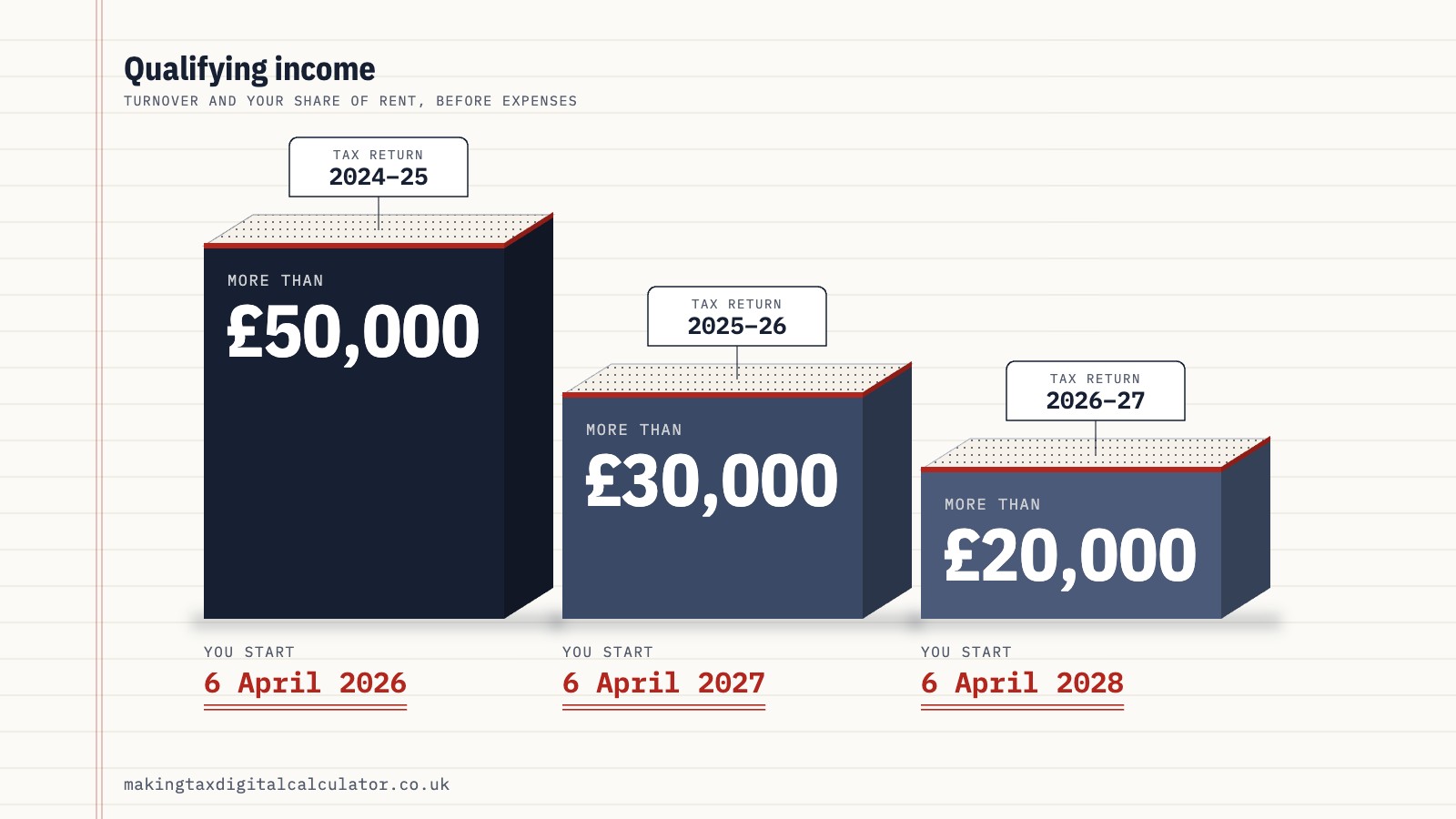
- If your 2024–25 tax return shows more than £50,000, you're in from 6 April 2026.
- If your 2025–26 tax return shows more than £30,000, you're in from 6 April 2027.
- If your 2026–27 tax return shows more than £20,000, you're in from 6 April 2028.
- Exactly the threshold isn't caught. The law's test is "more than".
- Once you're in, a lower income later doesn't take you out straight away.
This calculator takes your turnover and rent for one year and goes on to the April you start, your first year's dates and what a late update costs. To see which of your income counts and why, line by line, use the qualifying income calculator.
Sources: The Income Tax (Digital Obligations) Regulations 2026 (legislation.gov.uk); Find out if and when you need to use Making Tax Digital for Income Tax (GOV.UK); Use Making Tax Digital for Income Tax - Using Making Tax Digital for Income Tax for the first time (GOV.UK); and 3 more. Checked 6 November 2026.
All 6 sources
- The Income Tax (Digital Obligations) Regulations 2026 (legislation.gov.uk), checked 6 November 2026
- Find out if and when you need to use Making Tax Digital for Income Tax (GOV.UK), checked 6 November 2026
- Use Making Tax Digital for Income Tax - Using Making Tax Digital for Income Tax for the first time (GOV.UK), checked 6 November 2026
- Work out your qualifying income for Making Tax Digital for Income Tax (GOV.UK), checked 6 November 2026
- Find out if you can get an exemption from Making Tax Digital for Income Tax (GOV.UK), checked 6 November 2026
- SALF1440 - Self Assessment: the legal framework: Exemptions: Exemptions by reference to amount of income (HMRC manual), checked 6 November 2026
What counts, and what doesn't
Qualifying income is turnover and rent before expenses, not profit. Tap a branch to see how HMRC treats it.
COUNTS
LEFT OUT
Every branch, in words
- Self-employed turnover (counts). Self-employment income counts, taken before expenses (your turnover). Turnover from every business you run as a sole trader is added together.
- UK rents (counts). UK property income counts, taken before expenses. If you own a property with someone else, only your share counts.
- Your share of a joint let (counts). Only your share counts. HMRC's example: a property let for £50,000 a year, owned equally with a sibling, gives each of you £25,000.
- Foreign rents (counts). Foreign property income counts if you were UK resident for the tax year. If you were not, it does not.
- A part year, scaled up (counts). If all your self-employment and property income ran for only part of the year, it's scaled up to a full year, in proportion to how long it ran. HMRC does this for sole traders if it has the information. Landlords do it themselves. If some of your income ran all year, we don't scale the rest up, and we say what the other reading would give.
- Wages (PAYE) (left out). Pay from a job taxed through PAYE does not count.
- Pensions (left out). The State Pension does not count. Private pensions do not count.
- Partnership profit (left out). Your share of a partnership's profit does not count. You still put it on your tax return.
- Dividends (left out). Dividends do not count, including dividends from your own company.
- Savings interest (left out). Savings interest does not count. HMRC says all income other than self-employment and property is left out.
Sources: The Income Tax (Digital Obligations) Regulations 2026 (legislation.gov.uk); Taxes Management Act 1970, Schedule A1 (Digital reporting and record-keeping) (legislation.gov.uk); Work out your qualifying income for Making Tax Digital for Income Tax (GOV.UK); and 2 more. Checked 6 November 2026.
All 5 sources
- The Income Tax (Digital Obligations) Regulations 2026 (legislation.gov.uk), checked 6 November 2026
- Taxes Management Act 1970, Schedule A1 (Digital reporting and record-keeping) (legislation.gov.uk), checked 6 November 2026
- Work out your qualifying income for Making Tax Digital for Income Tax (GOV.UK), checked 6 November 2026
- Use Making Tax Digital for Income Tax - Add or cease income sources (GOV.UK), checked 6 November 2026
- Use Making Tax Digital for Income Tax - Create digital records (GOV.UK), checked 6 November 2026
Three thresholds, three Aprils
Each April is decided by the tax return from two years before. The red line is the qualifying income you typed above. Where it's higher than a column, that April catches you, if that year's return shows the same.
Income of exactly the threshold isn't caught. The law's test is "more than".
| More than | On your tax return for | You start |
|---|---|---|
| £50,000 | 2024–25 | 6 April 2026 |
| £30,000 | 2025–26 | 6 April 2027 |
| £20,000 | 2026–27 | 6 April 2028 |
Sources: The Income Tax (Digital Obligations) Regulations 2026 (legislation.gov.uk); Find out if and when you need to use Making Tax Digital for Income Tax (GOV.UK); and 3 more. Checked 6 November 2026.
All 5 sources
- The Income Tax (Digital Obligations) Regulations 2026 (legislation.gov.uk), checked 6 November 2026
- Find out if and when you need to use Making Tax Digital for Income Tax (GOV.UK), checked 6 November 2026
- Use Making Tax Digital for Income Tax - Using Making Tax Digital for Income Tax for the first time (GOV.UK), checked 6 November 2026
- Find out if you can get an exemption from Making Tax Digital for Income Tax (GOV.UK), checked 6 November 2026
- SALF1440 - Self Assessment: the legal framework: Exemptions: Exemptions by reference to amount of income (HMRC manual), checked 6 November 2026
How many people each April brings in
One figure is 100,000 people, from HMRC's count of 2023–24 tax returns.
HMRC has published different counts from different years of data. We use its Official Statistics (published 13 August 2025, based on 2023 to 2024 returns) and list the others.
- Other HMRC counts for the April 2026 group: 780,000 (Making Tax Digital for Income Tax Self Assessment for sole traders and landlords) and 860,000 (Act now: 864,000 sole traders and landlords face new tax rules in two months).
- Other HMRC counts for the April 2027 group: 970,000 (Making Tax Digital for Income Tax Self Assessment for sole traders and landlords).
- Other HMRC counts for the April 2028 group: 970,000 (Reduction of the mandation threshold from £30,000 to £20,000 from April 2028) and 900,000 (Technical note: Modernising the tax system through Making Tax Digital).
Sources: Making Tax Digital for Income Tax business population statistics: commentary (GOV.UK); Making Tax Digital for Income Tax Self Assessment for sole traders and landlords (GOV.UK); and 4 more. Checked 6 November 2026.
All 6 sources
- Making Tax Digital for Income Tax business population statistics: commentary (GOV.UK), checked 6 November 2026
- Making Tax Digital for Income Tax Self Assessment for sole traders and landlords (GOV.UK), checked 6 November 2026
- Reduction of the mandation threshold from £30,000 to £20,000 from April 2028 (GOV.UK), checked 6 November 2026
- Technical note: Modernising the tax system through Making Tax Digital (GOV.UK), checked 6 November 2026
- Act now: 864,000 sole traders and landlords face new tax rules in two months (HMRC press release, GOV.UK), checked 6 November 2026
- Sole traders and landlords earning more than £30,000 urged to act now (HMRC press release, GOV.UK), checked 6 November 2026
Who doesn't have to join
Some people are left out without asking. Others can ask HMRC to leave them out. Either way, you still send a Self Assessment tax return as normal.
AUTOMATIC
HMRC leaves you out
From what it already holds. You don't apply.
- Your qualifying income is £20,000 or less.
- You had no National Insurance number before the tax year began.
- You're acting for someone who has died, as their personal representative. Your own business or lettings may still count.
- Your 2024 to 2025 tax return included the Lloyd's page for your underwriting business.
- Your 2024 to 2025 tax return said you aren't physically or mentally capable of giving HMRC information, and someone in the UK acts for you under a power of attorney, or you have a deputy, controller or guardian.
- Partnerships don't use it yet, and nor do trusts or non-resident companies sending their own returns.
YOU APPLY
Digitally excluded
When it isn't reasonable for you to keep digital records and send updates with software, for example because:
- your age, a health condition or a disability stops you using a computer, tablet or smartphone for it;
- you're a practising member of a religious society or order whose beliefs are incompatible with using digital communications or keeping digital records, and you don't use a computer, tablet or smartphone for business or personal use;
- you can't get the internet at your home or business because of where you are, and can't get it anywhere else suitable.
HMRC won't accept it if the only reason is that you filed on paper before, don't know accounting software, have few records, or it will take extra time or cost.
You apply by phone or in writing to HMRC, which aims to reply within 28 calendar days. If you must start on 6 April 2026 or 6 April 2027, you can apply now. If you must start on 6 April 2028, apply from summer 2027 onwards.
Some exemptions are temporary, until April 2027 at the earliest. On 28 October 2026 the government announced that some of them will last until further notice, which isn't law yet. The exemptions guide goes through every one.
Sources: Taxes Management Act 1970, Schedule A1 (Digital reporting and record-keeping) (legislation.gov.uk); Find out if you can get an exemption from Making Tax Digital for Income Tax (GOV.UK); Apply for an exemption from Making Tax Digital for Income Tax (GOV.UK); and 2 more. Checked 6 November 2026.
All 5 sources
- Taxes Management Act 1970, Schedule A1 (Digital reporting and record-keeping) (legislation.gov.uk), checked 6 November 2026
- Find out if you can get an exemption from Making Tax Digital for Income Tax (GOV.UK), checked 6 November 2026
- Apply for an exemption from Making Tax Digital for Income Tax (GOV.UK), checked 6 November 2026
- Use Making Tax Digital for Income Tax - If your circumstances change (GOV.UK), checked 6 November 2026
- Budget 2026 — Overview of tax legislation and rates (OOTLAR) (Budget document, GOV.UK), checked 6 November 2026
Your first year, deadline by deadline
For someone starting on 6 April 2027. The deadlines are the same either way.
- 7 Aug 2027Saturday Quarterly update for 6 April to 5 July 2027 a late update earns a point*; falls on a Saturday
- 7 Nov 2027Sunday Quarterly update for 6 July to 5 October 2027 a late update earns a point*; falls on a Sunday
- 31 Jan 2028Monday First payment on account towards your 2027–28 tax if you make them
- 7 Feb 2028Monday Quarterly update for 6 October 2027 to 5 January 2028 a late update earns a point*
- 7 May 2028Sunday Quarterly update for 6 January to 5 April 2028 a late update earns a point*; falls on a Sunday
- 31 Jul 2028Monday Second payment on account towards your 2027–28 tax if you make them
- 31 Jan 2029Wednesday Tax return for 2027–28, and any of its tax still to pay a late return earns a point
Each update covers the tax year so far. You choose calendar quarters in your software before your first update.
With calendar quarters, the updates cover 1 April to 30 June 2027, 1 July to 30 September 2027, 1 October to 31 December 2027 and 1 January to 31 March 2028, with the same deadlines.
7 August 2027 is a Saturday, 7 November 2027 is a Sunday and 7 May 2028 is a Sunday. HMRC's own first-year timetable keeps weekend dates as deadlines, so plan to send by the date shown.
* An announced change could take these points away for people who join in April 2027. It isn't law yet: Late updates below says what it would change.
Payments on account aren't new with Making Tax Digital. Each one is half of last year's tax bill, and you don't make them if that bill was less than £1,000, or if more than 80% of it was paid outside Self Assessment, through your tax code for example.
Sources: The Income Tax (Digital Obligations) Regulations 2026 (legislation.gov.uk); Taxes Management Act 1970, section 59A (Payments on account of income tax) (legislation.gov.uk); Finance Act 2021, Schedule 24, Paragraph 5 (legislation.gov.uk); and 12 more. Checked 6 November 2026.
All 15 sources
- The Income Tax (Digital Obligations) Regulations 2026 (legislation.gov.uk), checked 6 November 2026
- Taxes Management Act 1970, section 59A (Payments on account of income tax) (legislation.gov.uk), checked 6 November 2026
- Finance Act 2021, Schedule 24, Paragraph 5 (legislation.gov.uk), checked 6 November 2026
- The Finance Act 2021 (Income Tax and Capital Gains Tax) (Penalties) (Appointed Day: Digitally Obligated Persons) Regulations 2026 (legislation.gov.uk), checked 6 November 2026
- Use Making Tax Digital for Income Tax - Send quarterly updates (GOV.UK), checked 6 November 2026
- Use Making Tax Digital for Income Tax - Submit your tax return (GOV.UK), checked 6 November 2026
- Use Making Tax Digital for Income Tax - Using Making Tax Digital for Income Tax for the first time (GOV.UK), checked 6 November 2026
- Understand your Self Assessment tax bill: Payments on account (GOV.UK), checked 6 November 2026
- Use Making Tax Digital for Income Tax - Create digital records (GOV.UK), checked 6 November 2026
- Use Making Tax Digital for Income Tax - If your circumstances change (GOV.UK), checked 6 November 2026
- Penalties for Making Tax Digital for Income Tax (GOV.UK), checked 6 November 2026
- Penalties for Making Tax Digital for Income Tax volunteers (GOV.UK), checked 6 November 2026
- Budget 2026 — Overview of tax legislation and rates (OOTLAR) (Budget document, GOV.UK), checked 6 November 2026
- Budget 2025 — Overview of tax legislation and rates (OOTLAR) (Budget document, GOV.UK), checked 6 November 2026
- 436,000 sole traders and landlords make their tax digital (HMRC press release, GOV.UK), checked 6 November 2026
Late updates: four points, then £200
One point for each deadline you miss, however many businesses were late. At 4 points there's a £200 penalty, and another £200 for each miss after that. That's HMRC's guidance. Try it below. Say you're in from 6 April 2027 and miss deadlines one after another.
2 missed deadlines · 2 points
No penalty yet
Last missed: the update due 7 November 2027.
Deadline by deadline
| Missed | Last one due | Points | Penalties so far |
|---|---|---|---|
| 1 | 7 Aug 2027 | 1 | £0 |
| 2 | 7 Nov 2027 | 2 | £0 |
| 3 | 7 Feb 2028 | 3 | £0 |
| 4 | 7 May 2028 | 4 | £200 |
| 5 | 7 Aug 2028 | 4 | £400 |
| 6 | 7 Nov 2028 | 4 | £600 |
| 7 | 7 Feb 2029 | 4 | £800 |
| 8 | 7 May 2029 | 4 | £1,000 |
No points for late quarterly updates in 2026 to 2027. A late tax return always earns a point. Points under 4 expire after 24 months. At 4, they're cleared only after 12 months of sending everything on time, with nothing left unsent from the 24 months before.
The Budget on 28 October 2026 announced that people who must join in April 2027 won't get points for late quarterly updates in 2027 to 2028. It isn't law yet, so the table counts points under the published rules. If it becomes law, the 2027 to 2028 updates in the table would earn no points, and missing all 8 would come to 4 points and £200 in penalties instead of £1,000. This page will follow the law once it is made.
The regulations that switched on the new penalties (SI 2026/370) cover people who were in Making Tax Digital in the 2026 to 2027 tax year. Budget 2025 announced that the government would legislate to bring everyone else under them from 6 April 2027. No regulations doing that were on legislation.gov.uk on 6 November 2026. HMRC's guidance already treats you as under the new penalties, and so does this page.
We work out when points expire from HMRC's guidance (a point goes 24 months after the deadline it was for) and Finance Act 2021, Schedule 24, paragraph 8 (all points go together at the threshold), and assume you meet every deadline not listed. HMRC's online account shows the dates it uses.
Sources: The Income Tax (Digital Obligations) Regulations 2026 (legislation.gov.uk); Finance Act 2021, Schedule 24 (legislation.gov.uk); Finance Act 2021, Schedule 24, Paragraph 5 (legislation.gov.uk); and 11 more. Checked 6 November 2026.
All 14 sources
- The Income Tax (Digital Obligations) Regulations 2026 (legislation.gov.uk), checked 6 November 2026
- Finance Act 2021, Schedule 24 (legislation.gov.uk), checked 6 November 2026
- Finance Act 2021, Schedule 24, Paragraph 5 (legislation.gov.uk), checked 6 November 2026
- Finance Act 2021, Schedule 24, Paragraph 8 (legislation.gov.uk), checked 6 November 2026
- Finance Act 2026, Section 262 (legislation.gov.uk), checked 6 November 2026
- The Finance Act 2021 (Income Tax and Capital Gains Tax) (Penalties) (Appointed Day: Digitally Obligated Persons) Regulations 2026 (legislation.gov.uk), checked 6 November 2026
- Get ready for MTD: an agent toolkit - Understanding Making Tax Digital for Income Tax (GOV.UK), checked 6 November 2026
- Penalties for Making Tax Digital for Income Tax (GOV.UK), checked 6 November 2026
- Use Making Tax Digital for Income Tax - Send quarterly updates (GOV.UK), checked 6 November 2026
- Penalties for Making Tax Digital for Income Tax volunteers (GOV.UK), checked 6 November 2026
- Budget 2025 — Overview of tax legislation and rates (OOTLAR) (Budget document, GOV.UK), checked 6 November 2026
- Budget 2026 — Overview of tax legislation and rates (OOTLAR) (Budget document, GOV.UK), checked 6 November 2026
- 436,000 sole traders and landlords make their tax digital (HMRC press release, GOV.UK), checked 6 November 2026
- Deadline approaches for first Making Tax Digital quarterly update (HMRC press release, GOV.UK), checked 6 November 2026
What to do next
In order, for someone starting on 6 April 2027. You sign up and send your updates on GOV.UK and in your own software, never on this site.
Check your figure
Add up your self-employed turnover and your share of any rent, before expenses, from your tax return. The calculator at the top does it line by line, and What counts shows which lines HMRC leaves out.
Choose software
You need software that works with Making Tax Digital for Income Tax. HMRC's software finder asks a few questions and gives you a list. Every product on it has been through HMRC's recognition process. HMRC doesn't recommend any of them, and neither do we.
Sign up on GOV.UK
You need to be registered for Self Assessment and to have sent a tax return in the last two years. Sign up on GOV.UK with the same user ID and password you use for Self Assessment. You can sign up before you have to, to get ready. HMRC also signs some people up itself: since September 2026 HMRC has been signing up people who need Making Tax Digital for the 2026 to 2027 tax year and have not signed up themselves, using the information it already holds. The sign-up guide says what HMRC asks for, and when it signs you up itself.
Keep digital records from day one
From 6 April 2027, keep a record of your business income and expenses in that software. If you sign up part-way through the tax year, you create digital records back to the start of the tax year, and they go into your first quarterly update.
Send your first update
Your first quarterly update is due by 7 August 2027. Your first year has every date after it.
If you do not think you need to use Making Tax Digital for Income Tax, contact HMRC.
Sources: Use Making Tax Digital for Income Tax - Get your software ready (GOV.UK); Choose the right software for Making Tax Digital for Income Tax (GOV.UK); Find out if and when you need to use Making Tax Digital for Income Tax (GOV.UK); and 4 more. Checked 6 November 2026.
All 7 sources
- Use Making Tax Digital for Income Tax - Get your software ready (GOV.UK), checked 6 November 2026
- Choose the right software for Making Tax Digital for Income Tax (GOV.UK), checked 6 November 2026
- Find out if and when you need to use Making Tax Digital for Income Tax (GOV.UK), checked 6 November 2026
- Sign up for Making Tax Digital for Income Tax (GOV.UK), checked 6 November 2026
- Sign up your client for Making Tax Digital for Income Tax (GOV.UK), checked 6 November 2026
- Use Making Tax Digital for Income Tax - Create digital records (GOV.UK), checked 6 November 2026
- Check what to do if HMRC has signed you up for Making Tax Digital for Income Tax (GOV.UK), checked 6 November 2026
Calculators and guides
Calculators
- Making Tax Digital Qualifying Income Calculator: Is Your Turnover and Rent Over £50,000, £30,000 or £20,000?
See which of your income counts towards Making Tax Digital, and why. Turnover and your share of rent are added before expenses, a part year is scaled to a full one, and the total is tested against the April it decides.
- Making Tax Digital Deadlines: Every Quarterly Update, Tax Return and Payment Date, 2026–27 to 2028–29
When each quarterly update, tax return and tax payment is due, for whichever April you start and with standard or calendar quarters. Turn the dial to any day to see what's due next and how long you have.
- Making Tax Digital Penalties Calculator: A £200 Fine at 4 Points, and 3% on Late Tax at Day 15 and Day 30
Mark your deadlines on the points card to see each point stamped, the day it goes, and when the £200 penalty starts. Then run a late tax bill along the meter past day 15, day 30 and beyond.
Guides
- Making Tax Digital for Landlords: Rent Before Expenses Over £30,000 Means April 2027, Your Share if Joint
When Making Tax Digital reaches a landlord, how a jointly owned let counts, and what you record and send for each property business. Put your own lets on the street and see which April catches you.