Making Tax Digital Exemptions: Who Is Exempt Automatically, Who Must Apply, and What Budget 2026 Announced
Most exemptions from Making Tax Digital for Income Tax are automatic, from what HMRC already holds. The rest you apply for by phone or letter. Drop your own case through the sieve to see which catch you, for which tax years, and what the Budget has only announced.
General information, not tax advice. HMRC decides what applies to you. For your own case, ask HMRC or a tax adviser.
Most people who are exempt from Making Tax Digital for Income Tax don’t have to do anything. HMRC gives the automatic exemptions from what it already holds, mostly from your 2024 to 2025 tax return, and you don’t contact it or apply. The rest you apply for by phone or letter, and they don’t count until HMRC writes to say yes. Whichever kind you have, you still send a Self Assessment tax return every year.
Some exemptions have no end date in the law. Others cover the 2026 to 2027 tax year and nothing after it, so a foster carer or someone living abroad can be exempt for 2026 to 2027 and in from 6 April 2027. The Budget on 28 October 2026 announced longer exemptions for some of those people. That isn’t law yet, and this page says so wherever it comes up.
Check your own case
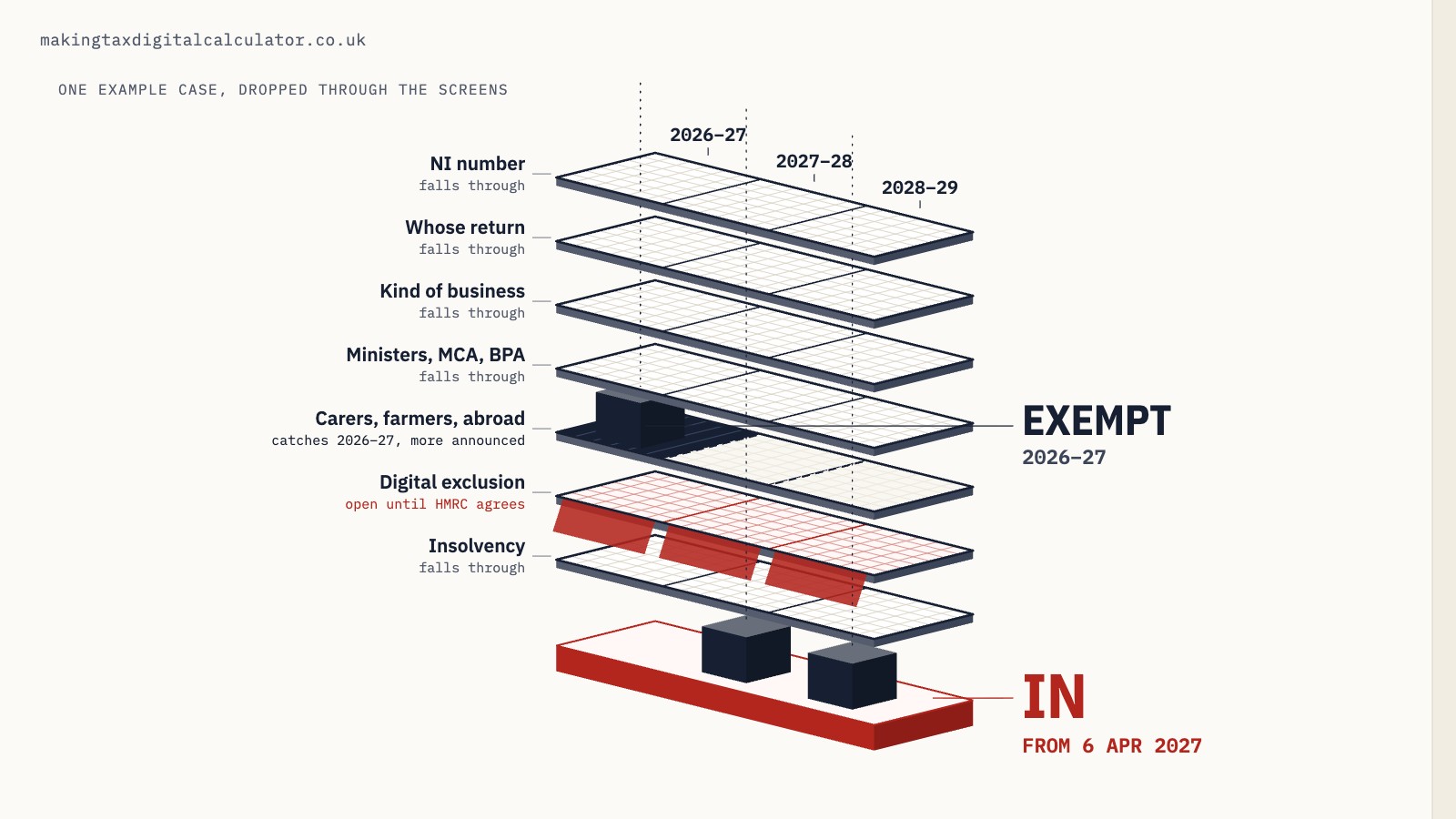
Each screen in the sieve is one question. Your case falls as a block for each tax year from 2026 to 2027. A screen that applies to you swings its mesh shut over the years its exemption covers and catches those blocks. If you have to apply, the mesh hangs open in red until HMRC agrees. Whatever gets through lands in the tray, and that’s a year you’re in. A year your income keeps you out of anyway falls as a small block that slips through every mesh, because there’s nothing to be exempt from.
| No. | The screen | Answers it catches, and for which tax years |
|---|---|---|
| 1 | National Insurance numberWhen did you get your National Insurance number? |
|
| 2 | Whose return it isWhose Self Assessment return is this? |
|
| 3 | Kind of businessWhere does your business income come from? |
|
| 4 | Ministers and two allowancesAre you a minister of religion, or do you get or transfer Married Couple’s Allowance or Blind Person’s Allowance? |
|
| 5 | Farmers, carers, trusts and life abroadDoes your tax return include one of these? |
|
| 6 | Digital exclusionIs it not reasonable for you to use software, because of your age, health, a disability, where you live or your religion? |
|
| 7 | InsolvencyAre you going through a formal insolvency procedure? |
|
The sieve opens on our example: qualifying income of £52,000, £36,000 and £38,000 on the 2024 to 2025, 2025 to 2026 and 2026 to 2027 returns, with qualifying care relief claimed on the first. It comes out as Exempt for 2026–27, then in from 6 April 2027. Making Tax Digital for Income Tax applies to you from 6 April 2027. Your 2025 to 2026 tax return decides it, with qualifying income of £36,000, which is more than £30,000. The Budget on 28 October 2026 announced that people eligible for qualifying care relief will be exempt until further notice. That isn’t law yet, so the sieve draws it in dashes and the later years still land in the tray.
Sources: The Income Tax (Digital Obligations) Regulations 2026 (legislation.gov.uk); Taxes Management Act 1970, Schedule A1 (Digital reporting and record-keeping) (legislation.gov.uk); Use Making Tax Digital for Income Tax – Add or cease income sources (GOV.UK); and 15 more. Checked 6 November 2026.
All 18 sources
- The Income Tax (Digital Obligations) Regulations 2026 (legislation.gov.uk), checked 6 November 2026
- Taxes Management Act 1970, Schedule A1 (Digital reporting and record-keeping) (legislation.gov.uk), checked 6 November 2026
- Use Making Tax Digital for Income Tax – Add or cease income sources (GOV.UK), checked 6 November 2026
- Find out if and when you need to use Making Tax Digital for Income Tax (GOV.UK), checked 6 November 2026
- Use Making Tax Digital for Income Tax – Using Making Tax Digital for Income Tax for the first time (GOV.UK), checked 6 November 2026
- Use Making Tax Digital for Income Tax – Create digital records (GOV.UK), checked 6 November 2026
- Find out if you can get an exemption from Making Tax Digital for Income Tax (GOV.UK), checked 6 November 2026
- Use Making Tax Digital for Income Tax – If your circumstances change (GOV.UK), checked 6 November 2026
- Work out your qualifying income for Making Tax Digital for Income Tax (GOV.UK), checked 6 November 2026
- Check what to do if HMRC has signed you up for Making Tax Digital for Income Tax (GOV.UK), checked 6 November 2026
- Sign up your client for Making Tax Digital for Income Tax (GOV.UK), checked 6 November 2026
- Sign up for Making Tax Digital for Income Tax (GOV.UK), checked 6 November 2026
- Apply for an exemption from Making Tax Digital for Income Tax (GOV.UK), checked 6 November 2026
- SALF1440 – Self Assessment: the legal framework: Exemptions: Exemptions by reference to amount of income (HMRC manual), checked 6 November 2026
- Technical note: Modernising the tax system through Making Tax Digital (GOV.UK), checked 6 November 2026
- Budget 2025 — Overview of tax legislation and rates (OOTLAR) (Budget document, GOV.UK), checked 6 November 2026
- Budget 2026 — Overview of tax legislation and rates (OOTLAR) (Budget document, GOV.UK), checked 6 November 2026
- Government announces phased mandation of Making Tax Digital for ITSA (HMRC press release, GOV.UK), checked 6 November 2026
The sieve runs the same rules as our Making Tax Digital calculator, from HMRC’s guidance and the regulations, in your browser. Nothing you type or pick is sent anywhere. It doesn’t ask for your National Insurance number, and you should never give it to a website. HMRC decides every exemption, so treat the result as an estimate.
Who is exempt from Making Tax Digital automatically?
You’re exempt automatically if you only trade in a partnership, if the return is a trust’s or a non-resident company’s, or if you act as someone’s personal representative. So are people without a National Insurance number, people who can’t deal with HMRC and have an attorney or deputy, Lloyd’s underwriters, ministers of religion, and people who get Married Couple’s Allowance or Blind Person’s Allowance. Farmers and creators on averaging relief, carers on qualifying care relief, and anyone filing the trusts and estates page or the residence page are exempt for 2026 to 2027 only. HMRC works it out from the information it holds, mainly your 2024 to 2025 return, so there’s no form and no phone call. If HMRC has got it wrong, that’s the time to contact it.
HMRC’s exemption page starts with income. Qualifying income of £20,000 or less keeps you out altogether, and the line is higher for 2026 to 2027 and 2027 to 2028. You’re in from 6 April 2026 only if your 2024–25 return showed more than £50,000, and from 6 April 2027 only if your 2025–26 return showed more than £30,000. That’s the threshold, and the qualifying income calculator adds up what counts. Everything on this page is about people whose income is over the line.
Partnerships
Partnerships don’t have to use Making Tax Digital for Income Tax yet, and no date has been set. Are partnerships exempt?, further down, says what that means for a partner’s own sole trade or lets.
Sources: Taxes Management Act 1970, Schedule A1 (Digital reporting and record-keeping) (legislation.gov.uk); Find out if you can get an exemption from Making Tax Digital for Income Tax (GOV.UK); Government announces phased mandation of Making Tax Digital for ITSA (HMRC press release, GOV.UK). Checked 6 November 2026.
Trusts and non-resident companies
A trust that files an SA900 return is automatically exempt, and that includes charitable trusts and trusts of non-registered pension schemes. So is a non-resident company that files an SA700. Their Self Assessment returns carry on as they are. If you’re a trustee with a business or lets of your own, those are yours, and they’re tested like anyone else’s.
Source: Find out if you can get an exemption from Making Tax Digital for Income Tax (GOV.UK). Checked 6 November 2026.
Personal representatives
If you’re dealing with the tax of someone who has died, you’re exempt in that role. HMRC asks that any Self Assessment returns still outstanding for them are completed. The exemption covers the role, not you. Your own self-employment or property income is a separate case and may still need Making Tax Digital.
Source: Find out if you can get an exemption from Making Tax Digital for Income Tax (GOV.UK). Checked 6 November 2026.
People without a National Insurance number
If you don’t have a National Insurance number before a tax year starts, you’re exempt for that year and can’t sign up for it. HMRC’s example is someone who gets their number on 30 April 2026 with qualifying income over £50,000 for 2024 to 2025. They’re exempt for the whole of 2026 to 2027. In law the test is whether you had a number on the last day of the tax year before. From the next tax year that starts after you get one, your income decides as it does for everyone else.
Source: Find out if you can get an exemption from Making Tax Digital for Income Tax (GOV.UK). Checked 6 November 2026.
Someone who can’t deal with HMRC, with an attorney or deputy
You’re automatically and permanently exempt, unless things change, if your 2024 to 2025 return said you aren’t physically or mentally able to give HMRC information, and you’ve either given someone in the UK a power of attorney that’s still in force, or had a deputy, controller or guardian legally appointed for you. The Budget on 26 November 2025 had announced the exemption for people under a deputyship, and the regulations include it.
Sources: Find out if you can get an exemption from Making Tax Digital for Income Tax (GOV.UK); Budget 2025 — Overview of tax legislation and rates (OOTLAR) (Budget document, GOV.UK). Checked 6 November 2026.
Lloyd’s underwriting
The law doesn’t count a Lloyd’s member’s underwriting business as a relevant activity, so it sits outside Making Tax Digital for good. HMRC picks it up from the SA103L page on your 2024 to 2025 return. If you also have self-employment or property income, you’re in the next group instead, which is exempt with no end date yet.
Sources: Taxes Management Act 1970, Schedule A1 (Digital reporting and record-keeping) (legislation.gov.uk); Find out if you can get an exemption from Making Tax Digital for Income Tax (GOV.UK). Checked 6 November 2026.
Ministers of religion, Married Couple’s Allowance and Blind Person’s Allowance
These groups are exempt beyond April 2027, and the law gives the exemption no end date. It covers you if your 2024 to 2025 return included the SA102M page as a minister of any faith or denomination, the SA103L page as a Lloyd’s member with self-employment or property income, or a claim to receive or transfer Married Couple’s Allowance (for those born before 6 April 1935) or Blind Person’s Allowance.
Don’t read “no end date” as “never”. HMRC says these groups will need to use Making Tax Digital in the future, and that it will set out a timeline. On 26 March 2025, at the Spring Statement, the government said they wouldn’t have to join during this Parliament.
Sources: Find out if you can get an exemption from Making Tax Digital for Income Tax (GOV.UK); Technical note: Modernising the tax system through Making Tax Digital (GOV.UK). Checked 6 November 2026.
Farmers, carers, trusts and estates, and life abroad
These people don’t need Making Tax Digital for 2026 to 2027, and as the law stands they need it from 2027 to 2028 if their qualifying income for 2025 to 2026 is more than £30,000. It applies if your 2024 to 2025 return did one of these.
- Claimed averaging relief on the SA103 page as an individual, as a farmer, a market gardener or someone who creates literary or artistic work.
- Claimed qualifying care relief, as a foster carer or kinship carer, for example.
- Included the SA107 page for income from trusts or estates.
- Included the SA109 residence page.
The SA109 page goes in for several reasons. HMRC lists being non-UK resident, being UK resident but tax resident somewhere else too, overseas workday relief, split year treatment, the temporary repatriation facility, the foreign income and gains regime, some former remittance basis cases, and being a non-UK resident entertainer or sportsperson. Any of them brings the same 2026 to 2027 exemption.
Sources: Find out if you can get an exemption from Making Tax Digital for Income Tax (GOV.UK); Budget 2025 — Overview of tax legislation and rates (OOTLAR) (Budget document, GOV.UK). Checked 6 November 2026.
Which exemptions do you have to apply for?
You apply when HMRC can’t see from your 2024 to 2025 return that you qualify: if you’re digitally excluded, if your next return will show something that exempts you, or if you’re already digitally excluded for VAT. Until HMRC agrees, carry on as if you’re in.
Digitally excluded: what HMRC means
You’re digitally excluded if it isn’t reasonable for you to use software to keep digital records, send quarterly updates or file your return. In law you may be a practising member of a religious society or order whose beliefs rule out electronic communications or records. Or, for any reason, including age, disability or where you live, it isn’t reasonably practicable for you to use them.
HMRC’s examples are these. Your age, a health condition or a disability stops you using a computer, tablet or smartphone. Your religious beliefs are against digital communication, and you don’t use a computer, tablet or smartphone for business or at home. Or you can’t get internet access at home or at work because of where you are, and there’s nowhere suitable nearby to use instead.
It also says what won’t do on its own. HMRC won’t accept an application if your only reason is that you’ve always filed on paper, that you don’t know accounting software, that you have only a few records each year, or that it will take you extra time or cost. It looks at each case separately, and the exemption may be permanent if your circumstances are. If a relative, a friend or an agent applies for you, it’s still your own circumstances that count.
Sources: Taxes Management Act 1970, Schedule A1 (Digital reporting and record-keeping) (legislation.gov.uk); Find out if you can get an exemption from Making Tax Digital for Income Tax (GOV.UK); Apply for an exemption from Making Tax Digital for Income Tax (GOV.UK). Checked 6 November 2026.
Something your next return will show
The automatic exemptions read your 2024 to 2025 return. If the thing that exempts you only starts appearing on your 2025 to 2026 or 2026 to 2027 return, HMRC can’t know yet, so you apply. That covers a new minister of religion, someone who starts to receive or transfer Married Couple’s Allowance or Blind Person’s Allowance, and anyone who reasonably expects to claim averaging relief or qualifying care relief, or to file the SA107 or SA109 page.
Partners have one of their own. If, as a partner who would otherwise need Making Tax Digital, you claimed averaging relief on the SA104 page for 2024 to 2025, or expect to on a later return, you apply for the 2026 to 2027 exemption. HMRC asks people not to apply without a good reason to think the return will show it.
Source: Find out if you can get an exemption from Making Tax Digital for Income Tax (GOV.UK). Checked 6 November 2026.
Already digitally excluded for VAT
If HMRC has already agreed you’re digitally excluded from Making Tax Digital for VAT, call the Self Assessment helpline rather than starting again. Have your National Insurance number and VAT registration number to hand, with the reason you’re excluded for VAT and whether anything has changed. If nothing has, HMRC will confirm you’re exempt for Income Tax too. If something has, you make a fresh application.
Source: Find out if you can get an exemption from Making Tax Digital for Income Tax (GOV.UK). Checked 6 November 2026.
How do you apply for a Making Tax Digital exemption?
You phone or write to HMRC. Its guidance describes no online form. Call the Self Assessment general enquiries line, or write to HMRC with “Making Tax Digital for Income Tax, digitally excluded application” or “Making Tax Digital for Income Tax, exemption application” as the subject. Agents use the Agent Dedicated Line. You can apply for yourself or for someone else.
HMRC needs your name, address and National Insurance number, and an explanation of why you think you should be exempt. Our suggestion is to be specific about what stops you, in plain words, rather than say you dislike computers.
HMRC aims to answer within 28 calendar days of getting your application. The letter says which exemption you have and how long it lasts. If HMRC says no, you can appeal up to 30 days after the date on the letter. Apply before you’d need to start.
| If you’d need Making Tax Digital from | Apply |
|---|---|
| 6 April 2026 | Now |
| 6 April 2027 | Now |
| 6 April 2028 | From summer 2027 onwards |
Sources: Taxes Management Act 1970, Schedule A1 (Digital reporting and record-keeping) (legislation.gov.uk); Apply for an exemption from Making Tax Digital for Income Tax (GOV.UK); Find out if you can get an exemption from Making Tax Digital for Income Tax (GOV.UK). Checked 6 November 2026.
If you’ve already signed up and your circumstances change, apply, and keep using Making Tax Digital while you wait to hear. A temporary exemption HMRC accepts means you won’t need to sign up until 2027 to 2028 at the earliest.
What an exemption changes, and what it doesn’t
An exemption takes away the digital part. You don’t keep digital records, send quarterly updates or file through compatible software. It doesn’t take away the tax return. You still report your income and gains in a Self Assessment return every year, by the usual deadline, and pay the tax the usual way.
It changes your penalties. If you’re exempt in 2026 to 2027, you stay on the current Self Assessment late filing and late payment penalties for that year. If you become exempt in 2027 to 2028, after joining, your penalty point threshold falls from 4 to 2, and any points you have fall with it so you’re no closer to a penalty than before. HMRC’s example is someone with three points, one short of the threshold, who drops to one point, still one short. The penalties calculator shows how points build up for the years you are in.
There’s a legal detail that helps people who become exempt part-way through a year. Where someone starts to fall into one of the described groups and tells HMRC, the regulations treat a digital obligation that had already arisen for that tax year as never having arisen.
Sources: Find out if you can get an exemption from Making Tax Digital for Income Tax (GOV.UK); Use Making Tax Digital for Income Tax – If your circumstances change (GOV.UK); Penalties for Making Tax Digital for Income Tax (GOV.UK); and 1 more. Checked 6 November 2026.
All 4 sources
- Find out if you can get an exemption from Making Tax Digital for Income Tax (GOV.UK), checked 6 November 2026
- Use Making Tax Digital for Income Tax – If your circumstances change (GOV.UK), checked 6 November 2026
- Penalties for Making Tax Digital for Income Tax (GOV.UK), checked 6 November 2026
- Apply for an exemption from Making Tax Digital for Income Tax (GOV.UK), checked 6 November 2026
Which exemptions end in April 2027?
The ones for farmers and creators on averaging relief, carers on qualifying care relief, people with trust or estate income, and anyone filing the residence page. In law they cover 2026 to 2027 and nothing after. From 2027 to 2028 you’re in if your qualifying income for 2025 to 2026 is more than £30,000, and from 2028 to 2029 the line drops to £20,000, tested on your 2026 to 2027 return. The chart below draws each exemption across the tax years. A bar that stops in red ends there. A bar that runs off the edge has no end date. Dashes are what the Budget announced.
| Exemption | 2026–27 | 2027–28 | 2028–29 | Later |
|---|---|---|---|---|
| No end date in the law | ||||
| Partnershipsuntil HMRC sets a date (none announced) | exempt | exempt | exempt | no end date |
| Trusts (SA900) and non-resident companies (SA700)permanent unless circumstances change | exempt | exempt | exempt | no end date |
| Personal representativesin that role only | exempt in that role | exempt in that role | exempt in that role | no end date |
| An attorney, deputy, guardian or controller acts for youpermanent unless circumstances change | exempt | exempt | exempt | no end date |
| Lloyd’s underwriting businesspermanent (outside Making Tax Digital) | exempt | exempt | exempt | no end date |
| Ministers of religionno end date in the law yet | exempt | exempt | exempt | no end date |
| Lloyd’s members with other incomeno end date in the law yet | exempt | exempt | exempt | no end date |
| Married Couple’s Allowanceno end date in the law yet | exempt | exempt | exempt | no end date |
| Blind Person’s Allowanceno end date in the law yet | exempt | exempt | exempt | no end date |
| No National Insurance numberfor each tax year that starts before you have one | exempt if the year starts before you have a number | exempt if the year starts before you have a number | exempt if the year starts before you have a number | until you have a number |
| 2026 to 2027 only, as the law standsThen you’re in from 2027 to 2028 if your qualifying income for 2025 to 2026 is more than £30,000. | ||||
| Averaging relief (farmers, market gardeners, creators)ends 5 April 2027 | exempt, ends 5 April 2027 | not exempt | not exempt | |
| Qualifying care relief (foster and kinship carers)ends 5 April 2027Announced 28 Oct 2026 until further notice, not law | exempt, ends 5 April 2027 | announced, not law | announced, not law | announced until further notice, not law |
| Trust and estate income (SA107)ends 5 April 2027 | exempt, ends 5 April 2027 | not exempt | not exempt | |
| Residence page (SA109), living abroadends 5 April 2027Announced 28 Oct 2026 until further notice, not law | exempt, ends 5 April 2027 | announced, not law | announced, not law | announced until further notice, not law |
| Residence page (SA109), other reasonsends 5 April 2027 | exempt, ends 5 April 2027 | not exempt | not exempt | |
| Non-UK resident entertainers and sportspeopleends 5 April 2027Announced 28 Oct 2026 until further notice, not law | exempt, ends 5 April 2027 | announced, not law | announced, not law | announced until further notice, not law |
| Only once HMRC agrees or confirms | ||||
| Digitally excludeddecided case by case, and may be permanent | exempt if HMRC agrees | exempt if HMRC agrees | exempt if HMRC agrees | no end date |
| Already digitally excluded for VATas HMRC confirms | exempt if HMRC agrees | exempt if HMRC agrees | exempt if HMRC agrees | no end date |
| Ministers and the two allowances, first on a later returnno end date in the law yet | exempt if HMRC agrees | exempt if HMRC agrees | exempt if HMRC agrees | no end date |
| The 2026–27 groups, first on a later returnends 5 April 2027 | exempt if HMRC agrees, ends 5 April 2027 | not exempt | not exempt | |
| Not an exemption | ||||
| Insolvencynot an exemptionThe Budget, 28 Oct 2026, repeated it for some who can’t sign up, not law | announced, not law | announced, not law | announced, not law | announced until further notice, not law |
Sources: The Income Tax (Digital Obligations) Regulations 2026 (legislation.gov.uk); Taxes Management Act 1970, Schedule A1 (Digital reporting and record-keeping) (legislation.gov.uk); Find out if and when you need to use Making Tax Digital for Income Tax (GOV.UK); and 15 more. Checked 6 November 2026.
All 18 sources
- The Income Tax (Digital Obligations) Regulations 2026 (legislation.gov.uk), checked 6 November 2026
- Taxes Management Act 1970, Schedule A1 (Digital reporting and record-keeping) (legislation.gov.uk), checked 6 November 2026
- Find out if and when you need to use Making Tax Digital for Income Tax (GOV.UK), checked 6 November 2026
- Find out if you can get an exemption from Making Tax Digital for Income Tax (GOV.UK), checked 6 November 2026
- Work out your qualifying income for Making Tax Digital for Income Tax (GOV.UK), checked 6 November 2026
- Use Making Tax Digital for Income Tax – Using Making Tax Digital for Income Tax for the first time (GOV.UK), checked 6 November 2026
- Use Making Tax Digital for Income Tax – Add or cease income sources (GOV.UK), checked 6 November 2026
- Check what to do if HMRC has signed you up for Making Tax Digital for Income Tax (GOV.UK), checked 6 November 2026
- Sign up your client for Making Tax Digital for Income Tax (GOV.UK), checked 6 November 2026
- Sign up for Making Tax Digital for Income Tax (GOV.UK), checked 6 November 2026
- Use Making Tax Digital for Income Tax – Create digital records (GOV.UK), checked 6 November 2026
- Use Making Tax Digital for Income Tax – If your circumstances change (GOV.UK), checked 6 November 2026
- Apply for an exemption from Making Tax Digital for Income Tax (GOV.UK), checked 6 November 2026
- SALF1440 – Self Assessment: the legal framework: Exemptions: Exemptions by reference to amount of income (HMRC manual), checked 6 November 2026
- Technical note: Modernising the tax system through Making Tax Digital (GOV.UK), checked 6 November 2026
- Budget 2025 — Overview of tax legislation and rates (OOTLAR) (Budget document, GOV.UK), checked 6 November 2026
- Budget 2026 — Overview of tax legislation and rates (OOTLAR) (Budget document, GOV.UK), checked 6 November 2026
- Government announces phased mandation of Making Tax Digital for ITSA (HMRC press release, GOV.UK), checked 6 November 2026
So the April 2027 date matters most to the people in the middle group. If that’s you and your income was over the line in 2025 to 2026, plan to be signed up and using software from 6 April 2027, keeping digital records from that day and sending your first quarterly update in the summer. The deadlines page has every date for that year. If the announcement becomes law first, some of you won’t need to.
What did Budget 2026 announce about exemptions?
On 28 October 2026 the Budget said the government will exempt people eligible for qualifying care relief, non-UK resident foreign entertainers and sportspeople, and expected non-resident customers from Making Tax Digital for Income Tax until further notice. It said the secondary legislation will come before April 2027. It also repeated that some people HMRC can’t provide a digital service for won’t have to use Making Tax Digital, and that this will include a small number of insolvent people who can’t currently sign up.
None of that is law yet. The regulations still exempt those groups for 2026 to 2027 only, and HMRC’s exemption guidance, last updated before the Budget, still says they’ll need Making Tax Digital from 2027 to 2028 if their income is over £30,000. Our sieve and calculator follow the law and draw the announcement beside it, in dashes, without applying it.
Averaging relief and trust or estate income, from the same 2026 to 2027 exemption, aren’t named, so they’re left as they are. And as we read it, “expected non-resident customers” is about living abroad, so someone filing the residence page for another reason, such as being resident in two countries, isn’t obviously covered. When the legislation is published we’ll update this page and the sieve.
Sources: Find out if you can get an exemption from Making Tax Digital for Income Tax (GOV.UK); Budget 2026 — Overview of tax legislation and rates (OOTLAR) (Budget document, GOV.UK); Budget 2025 — Overview of tax legislation and rates (OOTLAR) (Budget document, GOV.UK). Checked 6 November 2026.
Does insolvency exempt you from Making Tax Digital?
No. If you keep receiving self-employment or property income after entering a formal insolvency procedure, you keep using Making Tax Digital. An exemption from Making Tax Digital for VAT because of insolvency doesn’t carry over to Income Tax either. The one change on the way is the Budget announcement above, for a small number of insolvent people who can’t currently sign up, and that isn’t law yet.
Source: Find out if you can get an exemption from Making Tax Digital for Income Tax (GOV.UK). Checked 6 November 2026.
Are partnerships exempt from Making Tax Digital?
Yes, as the law stands. Partnerships don’t need to use Making Tax Digital for Income Tax, and no start date has been set. On 19 December 2022 the government said it wouldn’t extend Making Tax Digital to general partnerships in 2025 as it had planned, while staying committed to bringing them in. HMRC says it will set out the timeline later.
Being a partner doesn’t exempt the rest of your income. If you’re in a partnership and also run a sole trade, or let out a flat in your own name, those are added up as usual, and they can bring you in even though the partnership is out. Your share of the partnership’s profits doesn’t count towards your qualifying income.
Sources: Taxes Management Act 1970, Schedule A1 (Digital reporting and record-keeping) (legislation.gov.uk); Find out if you can get an exemption from Making Tax Digital for Income Tax (GOV.UK); Government announces phased mandation of Making Tax Digital for ITSA (HMRC press release, GOV.UK). Checked 6 November 2026.
What if your circumstances change?
Tell HMRC, and don’t stop anything until it answers. If you become exempt after signing up, because you can no longer use a computer, say, apply and carry on with Making Tax Digital while you wait. Once HMRC confirms the exemption, you stop keeping digital records and sending quarterly updates, and you still file a Self Assessment return.
It works the other way too. HMRC calls the lasting exemptions permanent unless your circumstances change, so an exemption can end when its reason does. If you get a National Insurance number, that exemption stops with the next tax year that starts after you have it. A partnership that breaks up and leaves you trading alone puts your own income back in the test. From then on your income decides, and the calculator works out which April.
Sources: Find out if you can get an exemption from Making Tax Digital for Income Tax (GOV.UK); Use Making Tax Digital for Income Tax – If your circumstances change (GOV.UK); Apply for an exemption from Making Tax Digital for Income Tax (GOV.UK). Checked 6 November 2026.
The family tree of exemptions
The tree puts every exemption in one family, by how it’s given. Automatic ones need nothing from you. Applications become agreed exemptions once HMRC’s letter arrives, and the dotted lines show which become which. The dashed lines join the 2026 to 2027 group to what the Budget announced for some of its members, a relationship that will only count if the law follows.
- 1Automatic from what HMRC holds
- 1.1Partnerships from 2026–27, until HMRC sets a date
- 1.2Trusts and non-resident companies from 2026–27, no end date
- 1.3Personal representatives in that role only
- 1.4No National Insurance number each year that starts without one
- 1.5An attorney, deputy, guardian or controller from 2026–27, no end date
- 1.6Lloyd’s underwriting business outside the rules altogether
- 1.7Ministers, Lloyd’s members with other income, and the two allowances from 2026–27, no end date in law
- 1.8Farmers, carers, trusts and life abroad 2026–27 only would run on as 2.1 to 2.3, if what was announced becomes law
- 2Announced 28 Oct 2026, not law
- 2.1Qualifying care relief until further notice
- 2.2Non-UK resident entertainers and sportspeople until further notice
- 2.3Expected non-residents until further notice
- 2.4No digital service, including some insolvent people not required
- 3You ask HMRC by phone or letter
- 3.1Digitally excluded case by case, may be permanent becomes 4.1 once HMRC agrees
- 3.2Already digitally excluded for VAT you call, HMRC confirms becomes 4.1 once HMRC agrees
- 3.3Ministers and the two allowances, first on a later return no end date in law becomes 4.2 once HMRC agrees
- 3.4The 2026–27 groups, first on a later return 2026–27 only becomes 4.2 once HMRC agrees
- 4Agreed by HMRC by HMRC’s letter
- 4.1Digitally excluded, agreed as HMRC’s letter says
- 4.2Any other application HMRC accepts for as long as the letter says
Sources: Taxes Management Act 1970, Schedule A1 (Digital reporting and record-keeping) (legislation.gov.uk); Find out if you can get an exemption from Making Tax Digital for Income Tax (GOV.UK); Apply for an exemption from Making Tax Digital for Income Tax (GOV.UK); and 5 more. Checked 6 November 2026.
All 8 sources
- Taxes Management Act 1970, Schedule A1 (Digital reporting and record-keeping) (legislation.gov.uk), checked 6 November 2026
- Find out if you can get an exemption from Making Tax Digital for Income Tax (GOV.UK), checked 6 November 2026
- Apply for an exemption from Making Tax Digital for Income Tax (GOV.UK), checked 6 November 2026
- Use Making Tax Digital for Income Tax – If your circumstances change (GOV.UK), checked 6 November 2026
- Technical note: Modernising the tax system through Making Tax Digital (GOV.UK), checked 6 November 2026
- Budget 2025 — Overview of tax legislation and rates (OOTLAR) (Budget document, GOV.UK), checked 6 November 2026
- Budget 2026 — Overview of tax legislation and rates (OOTLAR) (Budget document, GOV.UK), checked 6 November 2026
- Government announces phased mandation of Making Tax Digital for ITSA (HMRC press release, GOV.UK), checked 6 November 2026
Worked examples
These are our examples of HMRC’s rules, with people and figures we made up. Each one drops through the sieve at the top of the page if you press its button.
A foster carer with a cleaning business
Bridget fosters two children and claims qualifying care relief. She also runs a cleaning business. Her qualifying income was £52,000 on her 2024 to 2025 return, £36,000 on her 2025 to 2026 return and £38,000 on the next. Her income is over £50,000, so she’d have been in from 6 April 2026. The care relief on that return exempts her for 2026 to 2027 without her asking. As the law stands she’s in from 6 April 2027, because her second figure is over £30,000. If the Budget announcement becomes law before then, she stays exempt until further notice. She should get ready for April 2027 and watch for the legislation.
A carpenter who doesn’t use a computer
Tomasz is 74 and a self-employed carpenter. He has no computer or smartphone, and his eyesight makes screens hard to use. His qualifying income was £41,000, then £34,000, then £33,000. He isn’t in for 2026 to 2027, because his first figure is under £50,000, but his second figure brings him in from 6 April 2027. He can apply by phone or letter at any time before 6 April 2027, as digitally excluded, explaining what his age and eyesight stop him doing. “I’ve always done it on paper” wouldn’t be enough on its own. Until HMRC agrees, he should plan as if he’s in.
A minister who lets a house
Ade is a Methodist minister who files the SA102M page, and she lets out a house she owns. With her stipend counted elsewhere, her qualifying income from the let and some freelance writing was £57,000, then £59,000, then £60,000. She’s automatically exempt in every year we check, with no end date in the law. HMRC says ministers will need Making Tax Digital in the future, so she can expect a timeline at some point and shouldn’t throw away her spreadsheets.
A landlord who lives abroad
Elspeth lives in Portugal and lets four flats in a converted house in Leeds for £61,200 a year. She files the SA109 residence page each year. She’s exempt for 2026 to 2027 automatically. As the law stands she’s in from 6 April 2027, because her rent is over £30,000. The Budget on 28 October 2026 announced that expected non-residents will be exempt until further notice. It isn’t law yet, so she should get ready, or ask her agent to, and keep an eye out for the legislation. Making Tax Digital for landlords covers what changes for her lets.
Sources: Taxes Management Act 1970, Schedule A1 (Digital reporting and record-keeping) (legislation.gov.uk); Find out if you can get an exemption from Making Tax Digital for Income Tax (GOV.UK); Apply for an exemption from Making Tax Digital for Income Tax (GOV.UK); and 3 more. Checked 6 November 2026.
All 6 sources
- Taxes Management Act 1970, Schedule A1 (Digital reporting and record-keeping) (legislation.gov.uk), checked 6 November 2026
- Find out if you can get an exemption from Making Tax Digital for Income Tax (GOV.UK), checked 6 November 2026
- Apply for an exemption from Making Tax Digital for Income Tax (GOV.UK), checked 6 November 2026
- Technical note: Modernising the tax system through Making Tax Digital (GOV.UK), checked 6 November 2026
- Budget 2025 — Overview of tax legislation and rates (OOTLAR) (Budget document, GOV.UK), checked 6 November 2026
- Budget 2026 — Overview of tax legislation and rates (OOTLAR) (Budget document, GOV.UK), checked 6 November 2026